
Beyond 5 Whys: Implementing Socratic Questioning in Root Cause Analysis
Updated: Aug 11

Root cause analysis often relies on the 5 Whys technique, a simple method where a team asks "why" repeatedly to trace a problem back to its source. While popular, this approach has a hidden flaw: it treats every answer as true without testing assumptions. This can lead teams down a path of false conclusions, creating a convincing but inaccurate story about the problem’s cause.
Socrates, the ancient Greek philosopher, offers a valuable lesson for improving root cause analysis. He did not ask questions just to keep conversations going. Instead, he used questions to challenge assumptions, clarify meanings, and test the logic behind beliefs. Applying this Socratic method to the 5 Whys can transform it from a linear guessing game into a disciplined investigation.
This post explores how to combine Socratic questioning with the 5 Whys, using a practical example from the European Union Deforestation Regulation (EUDR). The goal is to help operations, compliance, and process improvement teams conduct more rigorous root cause analyses that lead to real solutions.
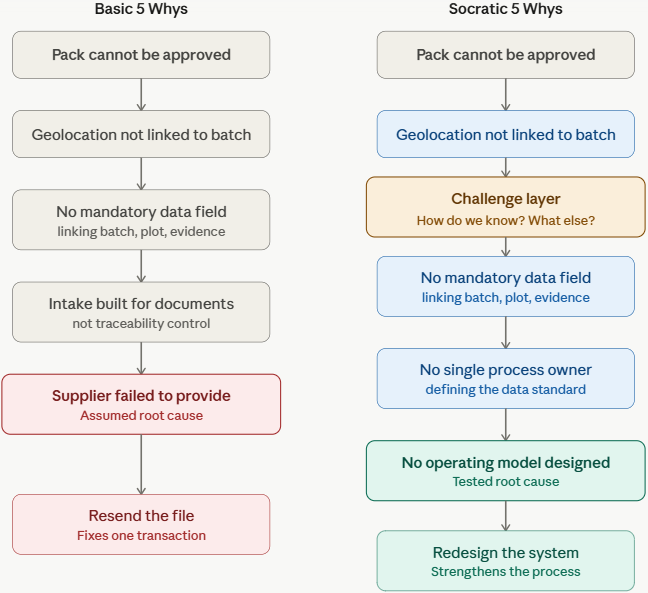
The Structural Weakness of the 5 Whys
The 5 Whys method asks a team to identify a problem and then ask "why" five times, each time building on the previous answer. The problem is that the method assumes every answer is true without verification. If the first answer is an assumption or guess, the entire chain of questioning can lead away from the real root cause.
For example, a team investigating a delayed shipment might ask:
Why was the shipment late? Because the truck broke down.
Why did the truck break down? Because it was not maintained.
Why was it not maintained? Because the maintenance schedule was missed.
Why was the schedule missed? Because the maintenance team was understaffed.
Why was the team understaffed? Because of budget cuts.
This story sounds plausible but may ignore other factors like poor communication, supplier delays, or incorrect data. The team never tested if the initial answers were accurate or if other explanations existed.
The 5 Whys often produces a neat story but not necessarily the truth.
What Socrates Teaches Us About Questioning
Socrates used questions to expose assumptions and force people to clarify their thinking. His method involved asking:
What exactly do you mean by that?
How do you know this is true?
What else could explain this?
What assumptions are you making?
These questions slow down the process and encourage critical thinking. They prevent teams from accepting answers at face value and push them to explore alternative explanations.
Applying this discipline to root cause analysis means not just asking "why" but also challenging each answer before moving on.
Adding a Challenge Layer to the 5 Whys
To improve the 5 Whys, insert a challenge layer after each answer:
Ask the original "why" question.
What do we mean by this answer exactly?
How do we know this answer is true?
Could something else explain this?
What assumptions are we making here?
When you get an answer, pause and apply Socratic questions:
Only after this challenge do you proceed to the next "why."
This approach turns the 5 Whys from a straight line into a disciplined investigation. It helps teams avoid jumping to conclusions and uncovers hidden causes or overlooked factors.
Practical Example: EUDR Traceability and Compliance
The European Union Deforestation Regulation (EUDR) requires companies to prove that relevant commodities and products placed on the EU market are deforestation-free and comply with local laws. This involves detailed traceability and due diligence.
Imagine a compliance team investigating why a shipment failed EUDR due diligence checks:
Why did the shipment fail the due diligence check? Because the supplier did not provide sufficient documentation.
Challenge: What exactly is “sufficient documentation”? How do we verify the supplier’s claim? Could there be other reasons for missing documents?
Why did the supplier not provide sufficient documentation? Because the supplier’s internal records were incomplete.
Challenge: How do we know the records are incomplete? Could the issue be with how records were requested or reviewed?
Why were the records incomplete? Because the supplier’s data collection process is manual and error-prone.
Challenge: What manual steps cause errors? Could training or technology gaps explain this?
Why is the data collection process manual? Because the supplier has not implemented automated traceability systems.
Challenge: Why has automation not been implemented? Is it cost, lack of awareness, or technical barriers?
Why has the supplier not invested in automation? Because of limited resources and low prioritization of compliance.
Challenge: What drives prioritization? Could regulatory pressure or customer demands change this?
By challenging each answer, the team uncovers deeper issues such as process weaknesses, resource constraints, and communication gaps. This leads to more targeted improvements like supplier training, technology upgrades, and stronger regulatory engagement.
Benefits of Socratic Questioning in Root Cause Analysis
Improves accuracy by testing assumptions and verifying facts.
Encourages critical thinking and deeper understanding.
Uncovers hidden causes that simple questioning misses.
Builds stronger consensus by clarifying meanings and logic.
Supports continuous improvement with better problem-solving.
How to Train Your Team in Socratic Root Cause Analysis
Teach the importance of questioning assumptions.
Practice applying the challenge layer in real problem-solving sessions.
Use role-playing to simulate Socratic questioning.
Encourage a culture where questioning is welcomed, not punished.
Document the questioning process to track insights and decisions.